
Executive Summary
Grow your restaurant sales with a custom restaurant ordering system that lowers fees, speeds up service, and delights every customer.
An established restaurant chain faced rising third-party fees and inefficient manual workflows. Orders came through multiple apps and handwritten tickets, causing errors, confusion, and lost time. To solve these issues, our team built a unified restaurant ordering system combining a web portal, back-office dashboard, and live kitchen display. As a result, direct sales surpassed 50%, administrative workload dropped by half, and order accuracy jumped from 85% to 97%. Customer satisfaction improved dramatically, and the system was approved for rollout across all branches.
Restaurant Ordering System Challenges
Each branch used separate systems for dine-in, takeaway, and delivery. Consequently, when a ticket went missing, service slowed while staff searched across devices and printed notes. Without a consolidated customer view, managers couldn’t track repeat orders or tailor promotions effectively.
Because of these disconnected processes, the business was losing time and money. Staff were frustrated, and guests were dissatisfied. Clearly, the restaurant needed a single, integrated ordering system that could streamline everything from kitchen workflow to customer experience.
Why Choose Our Restaurant Ordering System
The restaurant chain partnered with us because of our proven success in hospitality technology — including a tablet kiosk for a hotel café and a mobile ordering app for a food vendor. Moreover, they appreciated our rapid prototyping approach, which allowed staff to test real wireframes within days rather than weeks.
In addition, our commitment to hands-on training set us apart. We didn’t just deliver the software; we stayed until every staff member felt confident using it. Therefore, the client trusted us to handle a full-scale digital transition.
Project Overview: Building the Restaurant Ordering System
The project ran from February 2024 to July 2024. We used Flutter, Fast API, PostgreSQL, and RabbitMQ. The budget was optimised for small and medium-sized enterprises (SMEs) and scalable growth.
| Aspect | Details |
| Service | Mobile app |
| Technology | Flutter, Fast API , PostgreSQL and RabbitMQ |
| Period | February 2024 – July 2024 |
| Budget | Optimised for SME cost efficiency and scalable growth |
Our Custom Restaurant Ordering System Solution
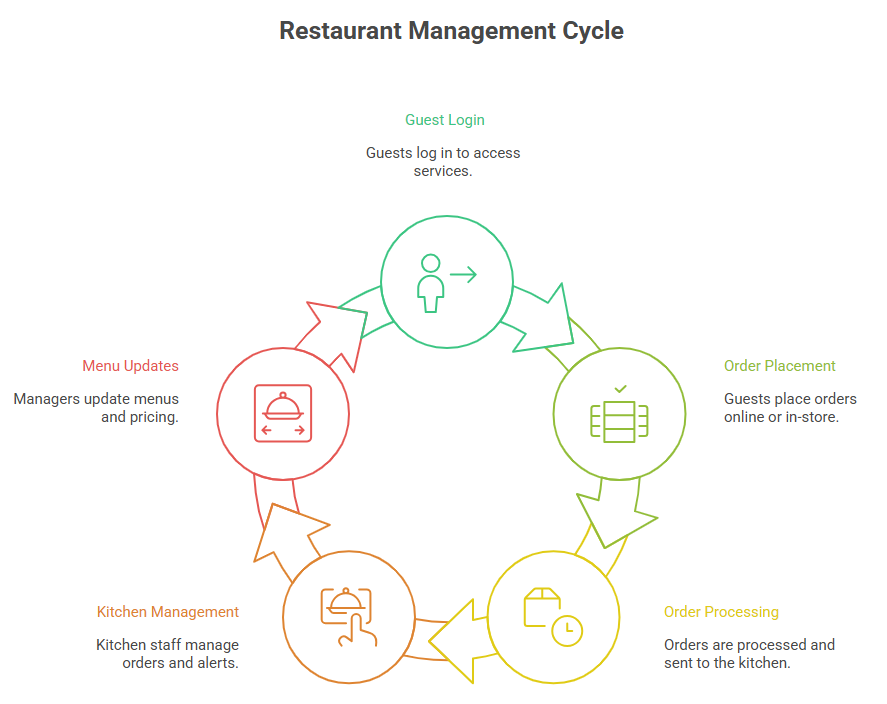
We launched a responsive web portal that unified takeaway, delivery, and table booking under one login. Customers could securely save payment methods, join loyalty programs, and manage all orders in one place.
Every order — whether placed online, through a delivery partner, or at a counter — flowed into a central kitchen queue visible on a touchscreen. As a result, staff received instant audio alerts for new tickets and overdue orders. Meanwhile, managers gained full control over real-time operations and customer trends.
Additionally, a built-in content management interface allowed managers to update menus, adjust pricing, and launch time-limited offers without external support.
Key Features of Restaurant Ordering System
- Unified dashboard for dine-in, takeaway, and delivery
- Real-time kitchen touchscreen with audio alerts
- Menu and pricing CMS with instant publishing
- Loyalty and rewards program for repeat customers
- Integrated reservation system with double-booking prevention
- Delivery API integration and live driver tracking
- Push notifications for offers and flash deals
Together, these features created a consistent and efficient workflow. Consequently, the restaurant team could focus more on serving customers and less on managing chaos.
Impact on Restaurant Sales & Efficiency
Within eight weeks of launch, direct restaurant sales overtook third-party orders, leading to significant commission savings. Administrative workload fell by 50%, and order accuracy climbed from 85% to 97%.
Furthermore, booking conversions improved from 40% to 54%, while the average party size grew by 10%. As a result, revenue and table utilisation both increased.
Customer feedback reflected these improvements. Overall satisfaction rose from 3.8 to 4.5 out of 5, primarily due to faster service and fewer mistakes. Additionally, the loyalty program encouraged repeat purchases — members placed 18% more orders than non-members. With targeted in-app promotions, the business saw a six-figure revenue boost within the first quarter after launch.
System Integration Challenges
Integrating the new restaurant ordering system with the legacy POS was not simple. Network interruptions triggered duplicate order events in the message queue, requiring fine-tuning of our RabbitMQ configuration.
To maintain stability, we ran both systems in parallel for several days. During that period, our team provided continuous on-site support. When the kitchen display began pushing too many alerts, we released a hotfix within 48 hours to refine the debounce logic and restore smooth operation.
Lessons Learned from Deployment
Simplifying the kitchen display into three views — New Orders, In Progress, and Ready for Pickup — drastically reduced cognitive load for staff. This change alone cut mis-tickets by 60%.
We also learned that in-person workshops work far better than digital guides. Because of this, we now include two full days of on-site training with every hospitality deployment.
Launching the loyalty program on day one was a major success factor. Members quickly engaged with offers and became high-value repeat customers, directly contributing to higher overall restaurant sales.
Next Steps: Boosting Restaurant Efficiency
The client’s next goal is to expand the restaurant ordering system with a mobile companion app. The app will send push notifications for flash deals and dine-in promotions, improving repeat business.
We’re also developing an AI-driven recommendation engine that suggests menu add-ons and combinations based on customer order history. Ongoing monitoring through the analytics dashboard will help optimise staffing, reduce waste, and improve profit margins.
Final Thoughts: Boost Restaurant Profitability
This case study proves how a custom restaurant ordering system can transform a restaurant chain’s efficiency and bottom line. By unifying all order channels, automating workflows, and providing real-time visibility, restaurants can cut costs, eliminate confusion, and deliver an exceptional guest experience.
In just two months, the restaurant achieved higher accuracy, faster service, and a loyal customer base — all while reducing dependence on costly delivery platforms.
Ready to streamline your restaurant’s operations and boost profitability? Our team is here to help. Get in touch today to discuss how our custom solutions can enhance your ordering system, reduce fees, and improve customer satisfaction. Contact us now to get started!
WRITTEN BY
August 18, 2025, Product Development Team
Top Categories
- Software Development ................... 7
- AI in Business ................... 5
- Digital Transformation ................... 5
- Technology ................... 3
- Uncategorized ................... 3